Shaker vs slab cabinet doors: which ages better
A ten-year look at shaker and slab cabinet doors: how each handles dents, grease, steam and repainting, and which rooms suit each one the best.

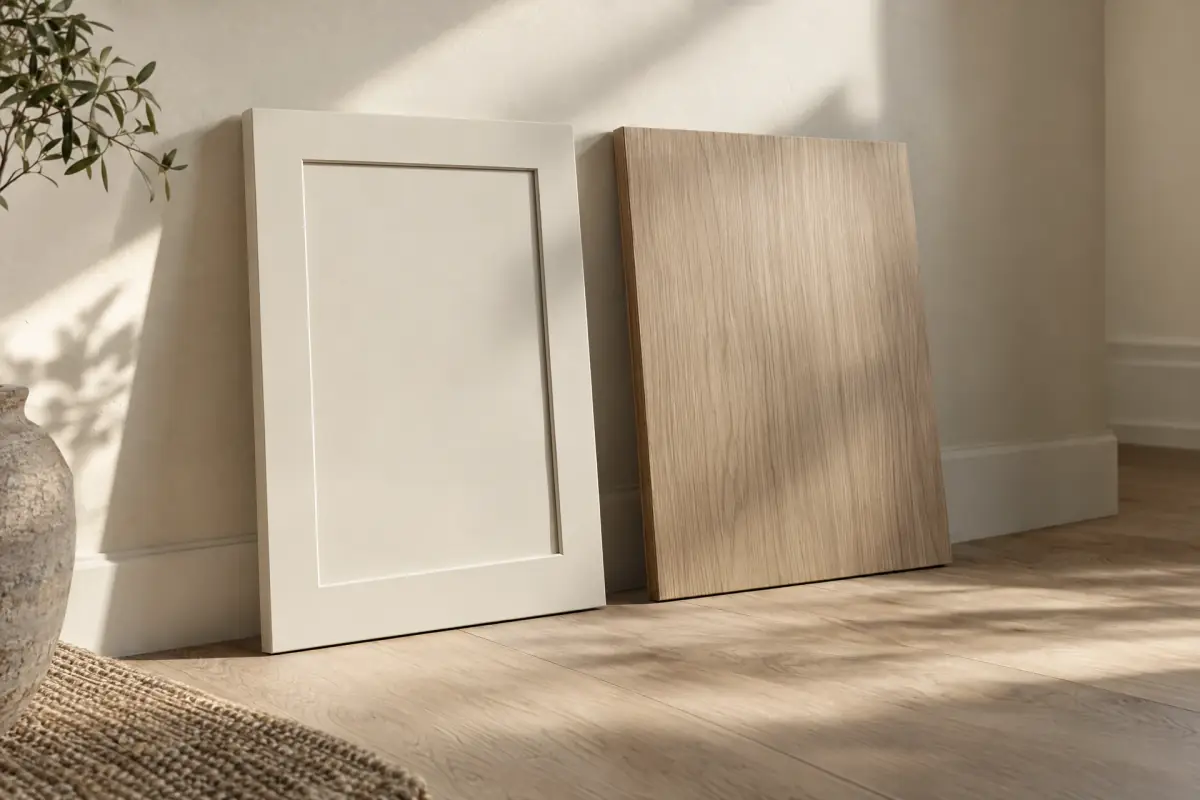
Both doors will still be on their hinges in ten years. The difference is what they look like when you get there. Shaker hides small damage in its joints and repaints gracefully, while slab shows every mark but wipes clean in one pass, so which one ages better depends on who uses the kitchen.
What each door actually is
A shaker door is a five-piece assembly: two stiles, two rails and a flat center panel set back from the face. The frame gives you something to pull and something to protect the panel edge. The shaker door is a recessed panel in a simple four-piece frame, and that simplicity is the whole point.
A slab door is one flat panel, full overlay, with no frame at all. Its only detail is the edge, square or eased or chamfered, and the shadow gap where it meets the next door. A slab door is a full-overlay flat panel, and that is the entire specification.
The joint is the whole story
On a shaker door, the panel floats inside the frame. The line between frame and panel is a deliberate shadow, and shadows are forgiving. On a slab door there is no joint, so your eye goes straight to the gaps, the edges and the plane of the face. That single difference explains most of what follows: shaker has places to hide, slab has nowhere to hide.
How each one takes a hit
A painted slab dents like a drum skin. The paint film cracks at the rim of the dent and the shadow under raking light makes it look deeper than it is. A shaker door dents just as easily on its flat panel, but a knock on a frame edge reads as a short line rather than a bruise across an empty field.
Grease is the quieter problem. Shaker’s recess and its joint lines collect airborne cooking grease, and a wet cloth skims over the corner instead of into it. Slab has one plane and one edge, so a single pass with a cloth and mild soap does the job.
Steam finds the weak point on each door. On a slab it is the exposed edge, especially on a painted MDF core, where water can get in and swell the board. On a shaker it is the joint between panel and frame, where steam can sit if the finish is thin.
Repainting favors shaker slightly. There are more edges to cut in, but a fresh coat bridges the joints and looks intentional. A repainted slab has to be sanded flat first, because any ridge or filled chip shows up in the sheen.
A ten-year damage ledger
- A dent in the middle of a door: visible on both, easier to fill and blend on a painted shaker panel.
- A chipped edge: repairable on painted MDF, hard to hide on a veneered slab.
- A film of cooking grease: a weekly wipe on slab, a brush-and-cloth job on shaker.
- Steam beside the dishwasher: the real risk for slab, and the reason edge sealing matters.
- A pulled hinge screw: a small repair on either, but a warning sign if it happens twice.
How the look dates
Shaker has period flexibility that is hard to argue with. It has been around for centuries and has never really left, which is why the same door works in a farmhouse, a city flat and a suburban kitchen from any decade. It reads as background. That is how it survives trends: it never tries to be the feature.
Slab is the opposite. It dates by alignment. A slab run looks superb when the boxes are square, the gaps are even and the edges are crisp. One door standing proud, one hinge that has sagged, one box that was never true, and the whole wall looks tired even though the doors are fine. Slab does not forgive the room around it.
There is a second dating risk for slab: edges. A square edge with a sharp paint line looks precise. A rounded-over edge with a thin paint film looks soft and slightly cheap, and no amount of cleaning fixes it. Shaker hides a mediocre edge inside a joint. Slab puts it on the outside where you look at it every day.
Where each one wins by room
In a small kitchen, slab wins. Fewer lines mean a calmer wall, and a flat front lets a narrow gap between doors read as a deliberate reveal rather than clutter. Slab fronts do make small kitchens feel bigger, with one condition: the boxes have to be square.
In a family kitchen, shaker wins. It takes knocks, hides them in the profile, and repaints without a specialist. It is also the safer choice if you might sell, because it does not ask the next owner to share your taste.
In a bathroom, it depends on the finish more than the style. A slab door with a sealed edge and a good exhaust fan is fine. A shaker door in a steamy bathroom is also fine, provided the joints are painted rather than left raw. If the room is genuinely damp, look at beadboard as a third option, because the planks are built to shed water and the grooves are easy to seal.
Cleaning and repair in real life
Weekly cleaning is a cloth and mild soap for both. The difference is the corners. Keep a soft brush near the sink for shaker frames, and wipe slab edges dry rather than letting water sit on them.
Repairs split into two kinds. Painted doors take filler and a touch-up coat, and a good color match disappears at standing height. Veneered or thermofoil doors are harder: a chip in the skin cannot be sanded out, and a patch will always catch the light. Solid wood slab doors can be sanded and re-oiled, which is the most forgiving option of all.
If you are weighing a full door swap against a repair, the refacing or replacing guide walks through the same decision at kitchen scale. The short version: one damaged door is a repair, a tired run is a project.
The ten-year comparison
| What you are judging | Shaker | Slab |
| — | — | — |
| Profile | Five-piece door, recessed panel, roughly a two-and-a-quarter-inch frame | Full-overlay flat panel, no frame, edge detail does the work |
| Repairability | Good when painted; dents fill and blend, joints hide small sins | Mixed; painted faces repair well, veneer and thermofoil chips do not |
| Cleaning | Corners and joint lines need a brush | One plane and one edge, the quickest wipe in the house |
| Cost direction | More parts and more assembly, so it tends to sit higher at the same finish level | Fewer parts and a simpler build, so it tends to sit lower at the same finish level |
| Best rooms | Family kitchens, resale-minded homes, painted schemes | Small kitchens, modern schemes, handleless runs |
Resale-neutral advice
Neither door adds value on its own. Buyers notice a kitchen that looks cared for, not a kitchen that looks fashionable. A clean shaker in a neutral color reads as finished. A slab in a strong color reads as recent, which is a different thing and can date faster.
Match the house. A slab run in a 1920s bungalow can look wonderful if the rest of the room agrees. A shaker run in a new build is safe, but it can feel like a costume if everything else is sharp and minimal.
Do not mix the two on the same wall. A slab run under shaker uppers looks like a delivery error, not a design decision.
What I would do
I would put shaker in the family kitchen and slab in the small one, and I would spend the difference on better hinges and a properly sprayed finish rather than on a more complicated door. Then I would keep a small pot of the wall color and a tube of filler in the utility drawer, because ten years is a long time and both doors will need a little help. The door that ages best is the one you can still touch up.
Keep reading
All guides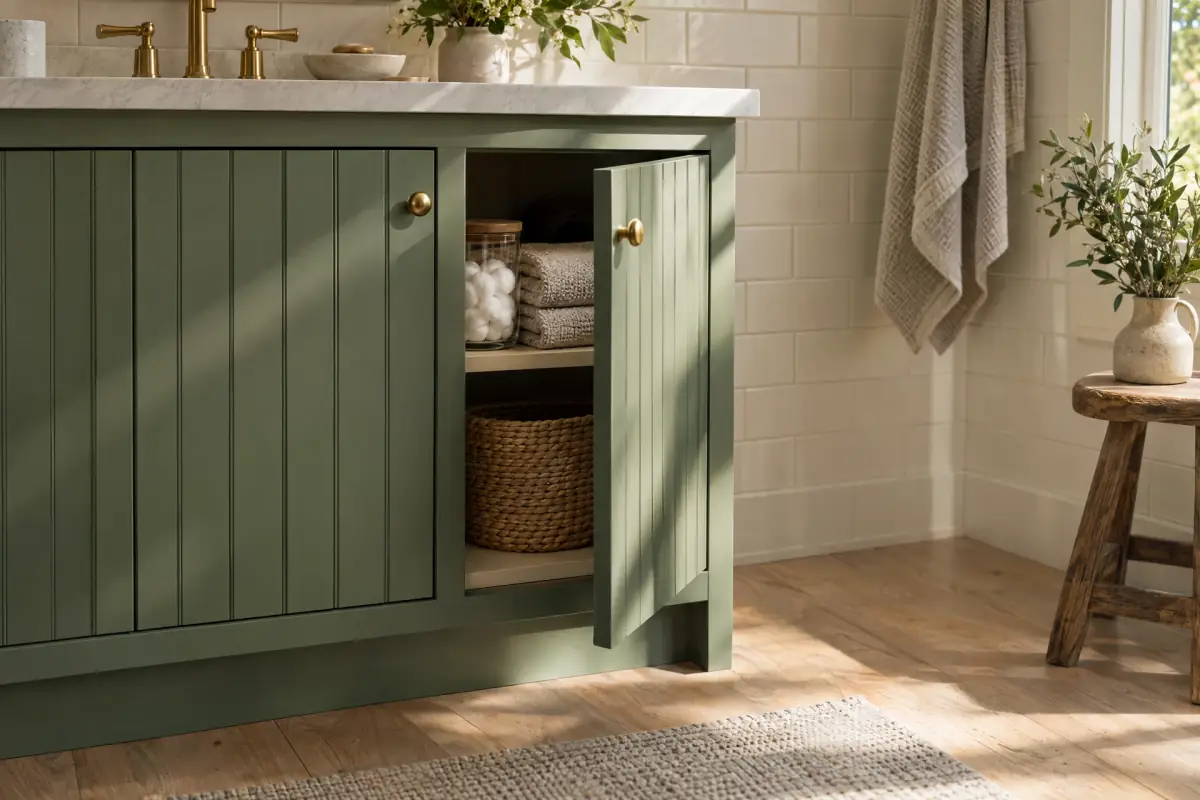
Beadboard cabinet doors: charm, minus the fuss
Where beadboard works, where it fights you, and how to specify it. Bead width, sealing, scale, and how to dodge the cottage-overload trap entirely.
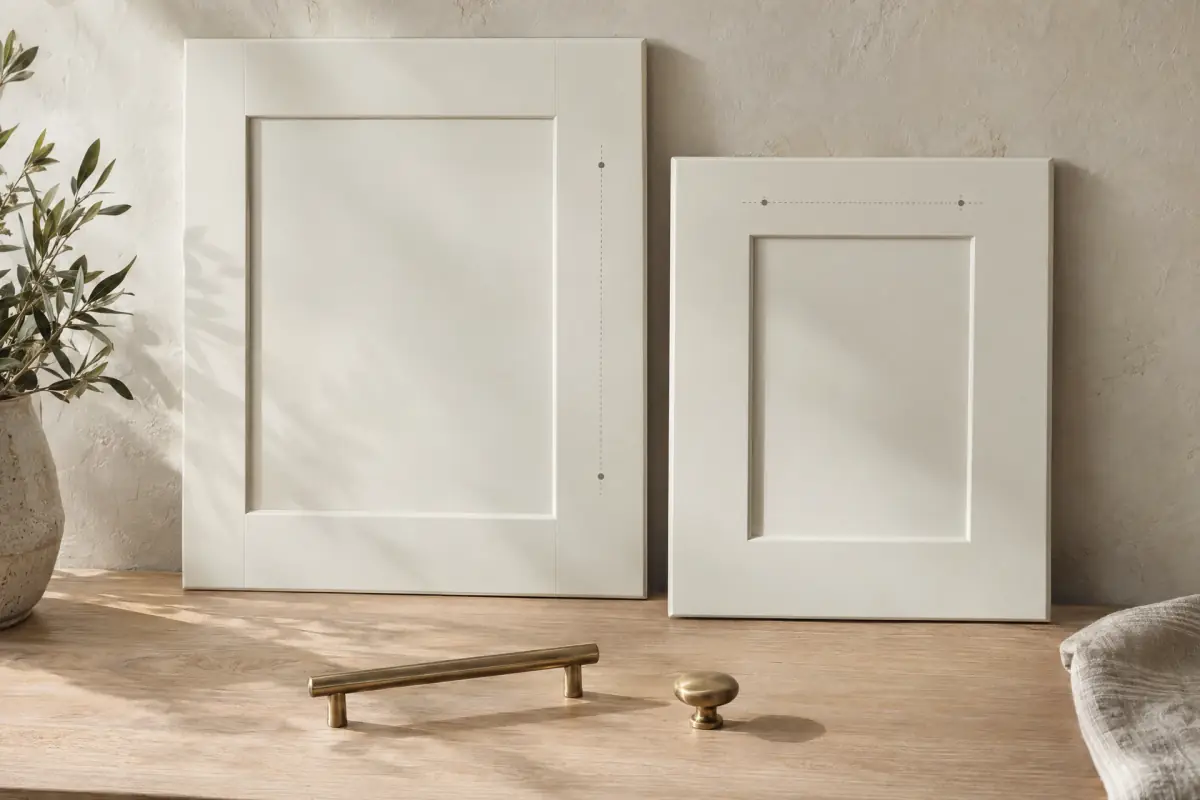
Hardware placement rules that look right
Knob or pull, and where exactly to put it. The placement rules that make a cabinet run look intentional, plus the mistakes that show up after drilling.