Refacing vs replacing cabinets: a decision checklist
A calm, ordered checklist for deciding whether to reface or replace your kitchen cabinets, with five physical checks and a clear decision table.

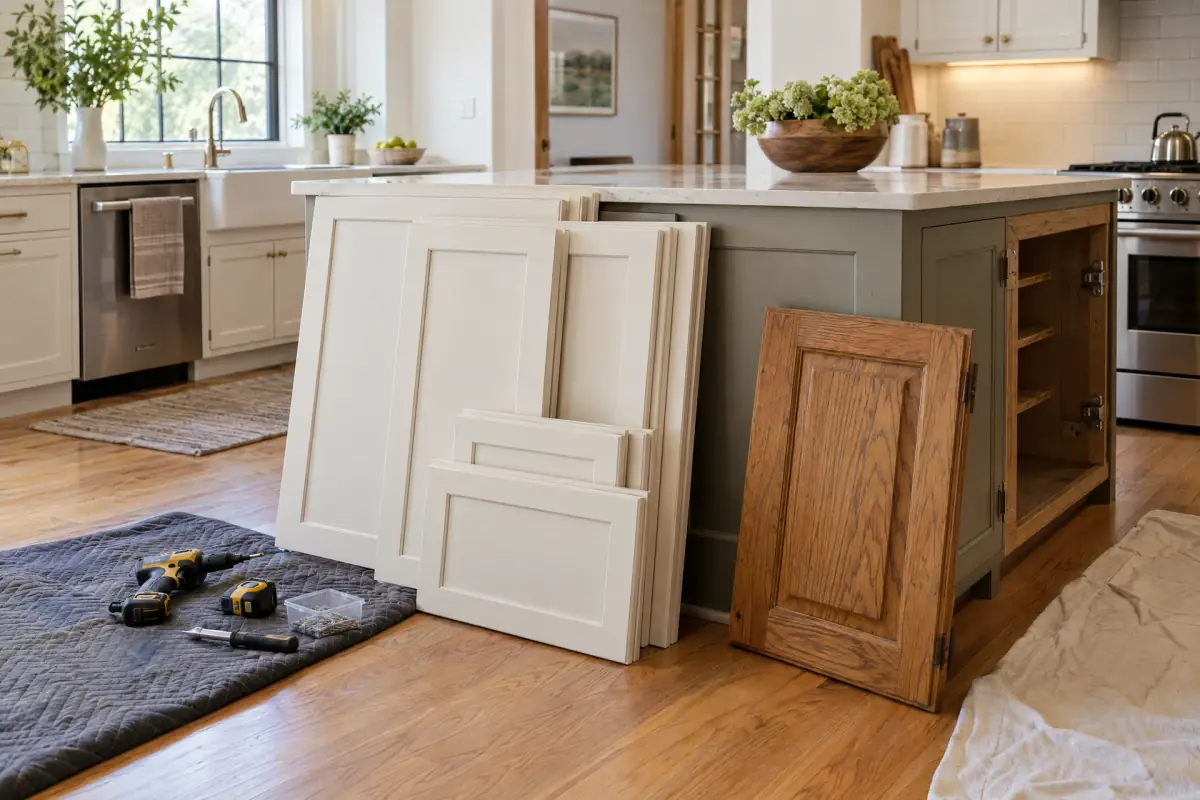
Refacing replaces the parts you see: doors, drawer fronts, the skin on the face frames and the hardware. Replacing replaces the boxes as well, which is the only way to change the layout. The honest question is not which one is cheaper, but whether your boxes are sound and whether you still like where everything sits.
What refacing actually replaces
Refacing is a skin job. The old doors and drawer fronts come off, the cabinet boxes stay fixed to the wall, and new fronts go on. The visible face of each box gets a matching veneer, laminate or a new face frame, so the old cabinet color does not show around the new doors. Hinges and pulls are usually new.
The skin on the boxes and the doors themselves are separate choices. The new fronts can be any door style that suits the room, while the frame skin is usually veneer or laminate. The materials guide explains which core suits which room.
Some firms also fit new drawer boxes and slides, because a new front on a tired drawer is a waste. Ask, because it changes both the job and the price.
What stays exactly where it is
The boxes, the countertop, the sink, the tile, the floor, the plumbing and the wiring. That is the appeal. You are not living through a demolition, and you are not choosing a new countertop because the old one got broken on the way out.
What refacing does not do is just as important. It does not move a sink, add a drawer stack where a door used to be, raise a cabinet to the ceiling or fix a box that has gone soft. It does not change the countertop. If any of those are on your list, refacing is the wrong tool, and the reface or replace guide will tell you the same thing in more detail.
The five checks
Set aside one evening. You need a flashlight, a tape measure, a spirit level, a screwdriver and a phone for photos. Work through the five checks in order and write down what you find. The order matters, because a fail at check one or check three usually ends the conversation.
1. Box condition
Open every door and pull every drawer out. Look at the bottom shelf, the back panel and the stiles around each opening. Press the board near the screws. Soft spots, sagging shelves, drawers that rub on the frame and a back panel that has pulled away are all signs that the box is tired.
2. Squareness
Measure both diagonals of each cabinet opening. If the two numbers differ, the box is racked. Then close the doors and look along the run: are the gaps even, or does the wall wave? An installer can shim a hinge and adjust a door. Nobody can make a racked box square without rebuilding it.
3. Water damage
Look under the sink first, then beside the dishwasher, then at the toe kick and around the fridge. Swollen board, bubbling veneer, dark staining and a musty smell are the signals. Water damage is the reason refacing jobs get called off after the doors come off, so check it before you commit.
4. Hinge screw bite
Hold a door open and try to lift it. Then tighten one hinge screw, gently. If it spins, the hole is stripped. One stripped hole is a small repair, using glue and a plug or a repair plate. Three or four loose hinges across a run means the board has lost its grip, and new doors will not fix that.
5. Layout dissatisfaction
This one is not physical, but it decides more jobs than the other four. Do you want the sink under the window, a taller fridge opening, a bank of drawers instead of a cabinet, or an island? Refacing cannot move plumbing, gas or a doorway. If the layout is the problem, new doors will only make the same layout look newer.
What to bring to the audit
- A flashlight, for the back corners of base cabinets.
- A tape measure, for diagonals.
- A spirit level, to check whether the run is straight.
- A screwdriver, for the hinge test.
- Your phone, to photograph every problem you find.
- A notepad, with the three things that annoy you most about the kitchen.
When replacing is the honest answer
Replacing is the right call when the layout is wrong, when water has reached more than one box, or when the boxes were never square to begin with. It is also the right call when the cabinet run is a patchwork of different ages and depths that has never lined up, because refacing will make that patchwork more obvious, not less.
There is a quieter case too. If the kitchen has already been refaced once, the face frames may be carrying a skin over a skin and screw holes over old screw holes. A second refacing can work, but it needs a careful look before anyone promises anything.
Disruption, timeline and dust
Refacing is a room-sized job, not a house-sized one. The team works in the kitchen, the sink and the stove usually stay usable, and the dust is mostly drilling and sanding rather than demolition. You will lose the use of one cabinet at a time while its doors are off, and you will want to clear the countertops before the first day.
Replacing is a sequence: strip out, wall and floor repairs, plumbing and electrical changes, new boxes, template for the countertop, then the countertop, then the backsplash. The kitchen is out of action for the middle of it, dust travels further than you expect, and the timetable depends on other trades. That is the real difference. Refacing is a facelift; replacing is a small building project.
What to ask a refacer
The answers tell you more than the brochure.
- What exactly is included: doors, drawer fronts, face frames, exposed ends, the inside of the boxes?
- Are the face frames veneered in place or replaced with new wood?
- Are the drawer boxes and slides new, or reused?
- Who removes the old doors, and who takes them away?
- How is the new skin finished at the sink and beside the dishwasher, where water sits?
- Can I see a sample door and a corner sample of the veneer or laminate?
- What happens if a box turns out to be damaged once the doors are off?
- What is the finish warranty, who honors it, and for how long?
- Is hardware included, and who drills the new pull holes?
The decision table
| If you see this | Refacing or replacing | Why |
| — | — | — |
| Boxes sound, square and dry, but the doors are tired | Refacing | You pay for the part that looks worn and keep the part that still works |
| One soft box under the sink, the rest solid | Replace that run | Water damage does not stop at the door, and a new front on a swollen box will not last |
| Staining or swelling in several boxes | Replacing | The damage is structural, not cosmetic |
| Hinges loose in three or four doors | Replacing, or a carpenter’s repair first | The board has lost its grip, and new doors add weight to a weak box |
| The layout no longer works | Replacing | Refacing cannot move plumbing, gas or a doorway |
| A patchwork of cabinet ages and depths | Replacing | New fronts make mismatched boxes more obvious, not less |
| Boxes fine, but the kitchen has been refaced before | Either, after inspection | A second skin can work, but old holes and old veneer need checking |
| You are selling in a year or two | Refacing | It is the lower-disruption way to make the kitchen read as cared for |
The bottom line
Walk the five checks before you call anyone. If the boxes are dry, square and solid, refacing gives you a new kitchen without a demolition, and that is a genuinely good deal. If the layout is wrong or the board has gone soft, replacing is not the expensive option. It is the only one that fixes the problem. Decide with your hands and a flashlight, not with a brochure.
Keep reading
All guides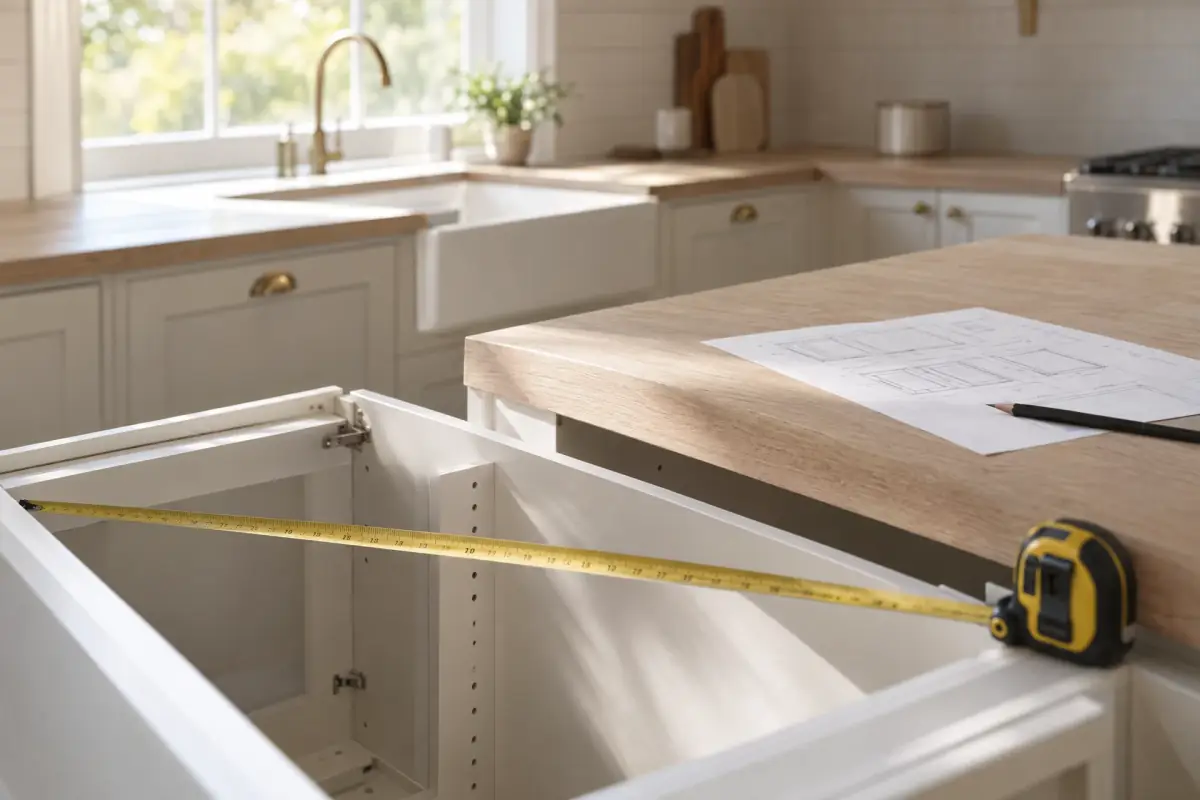
How to measure cabinet doors without guessing
Measure the opening, fix the overlay, and record every door once. A practical door schedule that keeps you out of the reorder queue for good.