Measuring guide
Measure once. Order once.
A replacement door is made to the number you send. This is the sequence a fitter uses to get that number right, including the three measurements most people skip.
What you need
- A metal tape measure, not a fabric one
- A small spirit level
- A screwdriver to check hinge type
- Paper, pencil and sticky notes
- A feeler gauge, or a folded piece of paper
-
Decide what you are measuring
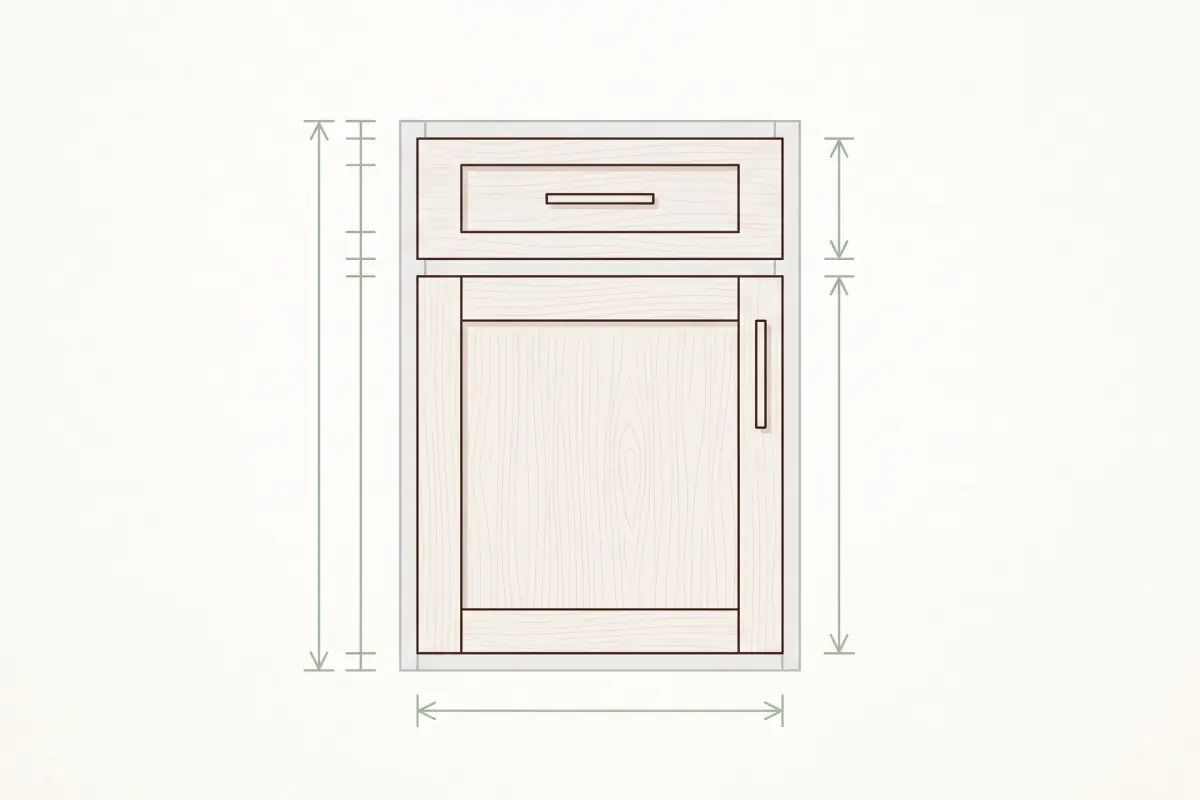
If you are keeping the boxes, measure the opening and the existing door. If you are ordering a full replacement front, measure the opening and note the overlay. These are different numbers and mixing them up is the most common ordering mistake.
-
Measure the opening width in three places
Measure across the top, the middle and the bottom of the opening. Write down all three. If they differ by more than about 2 mm, use the smallest number and note the difference — the box is not square.
-
Measure the opening height in three places
Measure down the left, the centre and the right of the opening. Again, record all three and work from the smallest. Check whether the top rail is level before you assume the opening is a rectangle.
-
Note the overlay and the reveal
Full-overlay doors cover most of the face frame; inset doors sit inside it. Measure how much of the frame the existing door covers on each side. For inset, measure the reveal gap at all four edges with a feeler gauge or a folded piece of paper.
-
Check the diagonals
Measure corner to corner both ways across the opening. If the two diagonals match, the opening is square. If they differ by more than a few millimetres, the door will need a wider reveal or the box needs attention.
-
Record hinge side and bore positions
Stand in front of the cabinet and note which side the hinges are on. Measure the distance from the top and bottom of the door to the hinge cup centre, and the distance from the door edge to the bore centre. Photograph the hinge with a ruler in frame.
-
Build a door schedule
Make one row per door and drawer front: room, cabinet reference, opening width and height, existing door width and height, overlay, hinge side, notes. Number the cabinets on a simple sketch so the schedule and the kitchen match.
-
Check the numbers before you order
Measure everything a second time on a different day, and compare. Ask someone else to read the tape for the awkward ones. Then check the schedule against the maker’s order form, line by line, before you pay a deposit.
Why width changes everything
A door that is 6 inches wider is not just bigger — it is heavier, it swings further, and it needs a different hinge. Slide to feel the proportion change.
A 24 inch door is the workhorse of upper runs. Slide to see how a wider front changes the proportions of the same opening.
A door schedule that works
One row per front. Number the cabinets on a sketch first, then fill this in. Take a photo of each row next to the cabinet it belongs to.
| Ref | Location | Opening W × H (mm) | Existing door W × H (mm) | Overlay | Hinge side |
|---|---|---|---|---|---|
| A1 | Base, left of sink | 600 × 720 | 597 × 717 | Full | Right |
| A2 | Base, sink | 900 × 720 | — | Full | Pair |
| B1 | Upper, left | 600 × 700 | 597 × 697 | Full | Left |
| B2 | Upper, corner | 500 × 700 | 497 × 697 | Full | Right |
The numbers above are an example of the format, not a standard size. Measure your own openings and write down what you find.
Four mistakes that cost a re-order
Measuring the old door only
The old door may have been trimmed on site or swollen over time. The opening is the truth; the old door is a cross-check.
Rounding to the nearest inch
Replacement fronts are made in millimetres. A rounded number becomes a visible gap or a door that will not close.
Ignoring the hinge bore
A new door needs the hinge cup drilled in the same place, or the door will not hang on the existing plate. Measure the bore, do not assume it.
Not checking the diagonals
A box can be 2 mm out of square and look fine until a full-overlay door is fitted. The diagonal check takes ten seconds and explains most mysterious gaps.
Next: decide whether refacing is worth it, then choose a material that suits the room.