Materials

Five materials. Five different failure modes.

Every cabinet door will eventually fail at something: water, a chair leg, a hinge screw or the sun. Choose the failure you can live with, and the finish that hides it.

  • 5 materials
  • Updated November 2026
  • 11 min read

Medium-density fibreboard

MDF

Moisture
Low tolerance
Knocks
Dents rather than chips
Hinges
Good, with the right inserts
Cost
Lower to middle

Wood fibres glued and pressed into a dense, uniform sheet. It machines beautifully, which is why it is the default core for painted shaker doors.

What it does well

  • Smooth, paint-ready surface
  • Stable in normal room humidity
  • No grain to fight the profile

Where it bites

  • Swelling is permanent once wet
  • Hinges can loosen if the screw holes strip
  • Heavy on wide doors

Layered veneer core

Plywood

Moisture
Moderate tolerance
Knocks
Chips at the edges
Hinges
Very good
Cost
Middle

Thin layers of wood glued at right angles. The cross-grain construction resists warping and holds a screw far better than MDF.

What it does well

  • Strong screw and hinge grip
  • Handles humidity swings better
  • Lighter than MDF for the same thickness

Where it bites

  • Edges need a lipping or band
  • Cheap grades have voids inside
  • Face veneer can telegraph through paint

Stiles, rails and panels in one timber

Solid wood

Moisture
Depends on the species and finish
Knocks
Dents and scratches
Hinges
Excellent
Cost
Highest

The traditional option: a frame and panel made from solid timber, usually oak, maple, walnut or pine. It can be stained, and it can be repaired.

What it does well

  • Repairable and refinishable
  • Takes a stain properly
  • Feels substantial in the hand

Where it bites

  • Moves with the seasons
  • Costs the most
  • Can crack along the grain

PVC foil wrapped over a core

Thermofoil

Moisture
Good on the face, weak at seams
Knocks
Resists knocks, but cannot be repaired
Hinges
Depends on the core
Cost
Lower to middle

A thin vinyl skin vacuum-formed over an MDF or particleboard core. It gives a seamless, wipe-clean surface with no painting.

What it does well

  • Wipe-clean and water-resistant
  • Consistent colour
  • No repainting

Where it bites

  • Can peel at the edges near heat
  • Not repairable if it lifts
  • Limited to flat or simple profiles

Resin-impregnated paper on a core

Laminate

Moisture
Good, if the edges are sealed
Knocks
Resists most knocks
Hinges
Depends on the core
Cost
Lower

A hard decorative layer bonded to a core, usually with a matching edge band. It is the workhorse of rental kitchens and utility rooms.

What it does well

  • Very hard-wearing
  • Wide range of colours and textures
  • Easy to clean

Where it bites

  • Edges are the weak point
  • Cannot be repaired invisibly
  • Can look flat up close

The one-table version

Cabinet door materials compared
Material Best for Weak point Finish pairing Cost direction
MDF Painted shaker and slab Water swelling Paint Lower to middle
Plywood Wide doors, humid rooms Edge chipping Veneer, paint with lipping Middle
Solid wood Stained traditional doors Seasonal movement Stain, oil, paint Highest
Thermofoil Wipe-clean family kitchens Peeling at heat None — the foil is the finish Lower to middle
Laminate Utilities and rentals Edge lifting None — the laminate is the finish Lower

What a door is made of

Five layers between you and a decision

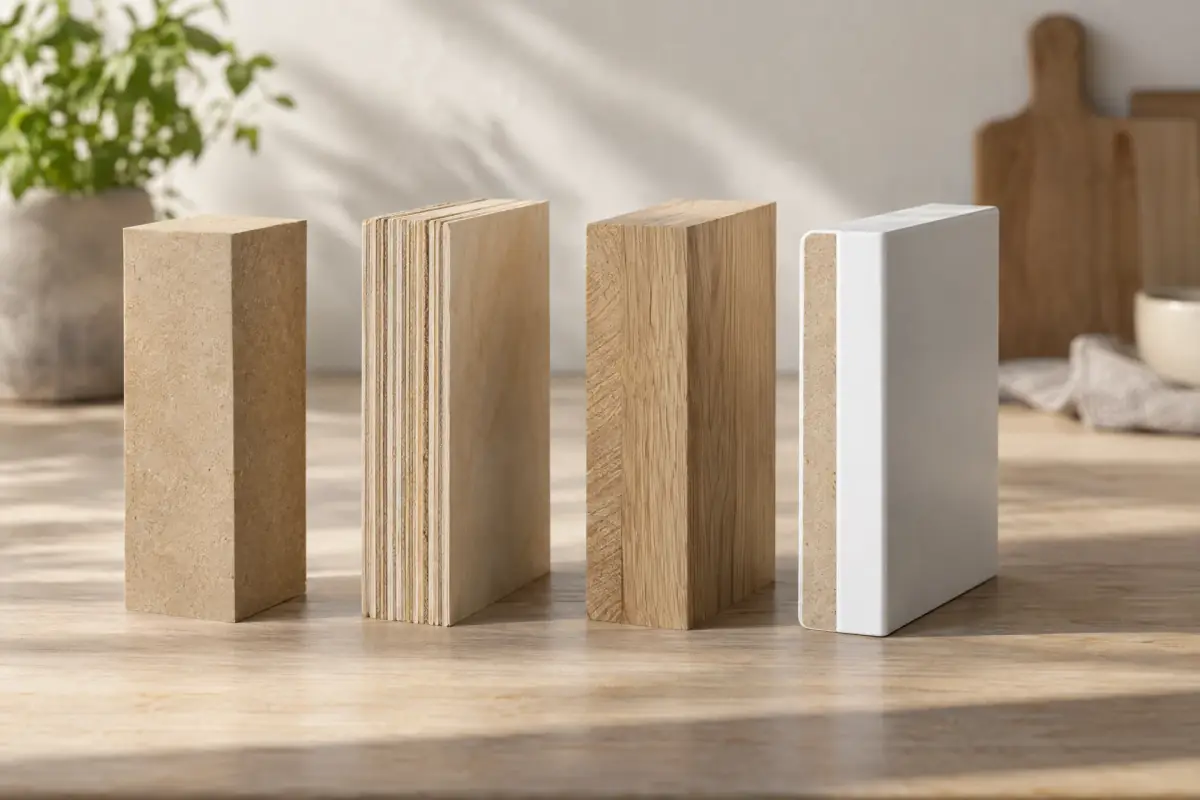
A cabinet door is not one material. It is a face, a core, an edge and a finish, and each one fails in a different way. Pull the stack apart and the price differences start to make sense.

Compare the five materials
  1. Finish Paint, stain, foil or laminate — the only part you touch.
  2. Door face The panel and frame. Style lives here.
  3. Core MDF, plywood or solid wood. Strength and weight.
  4. Box The carcass. Usually the part worth keeping.
  5. Pull The last 5% of the budget and 50% of the feel.

The last five per cent

Hardware changes the feel more than the material

A cheap knob on a good door feels worse than a good pull on an average one. Pick the pull after the door style, not before — the profile decides what looks intentional.

Bar pulls suit slab and shaker. Cup pulls belong with beadboard and raised panel. Edge pulls only work if the door has a routed finger groove, which is a machining decision, not an accessory.

See which pull suits which door

Pick a pull

Same door. Four different feels.

More on materials

All materials guides