MDF vs plywood vs solid wood cabinet doors
MDF, plywood and solid wood behave differently in a cabinet door. How each core handles moisture, hinges and paint, and which rooms suit each.

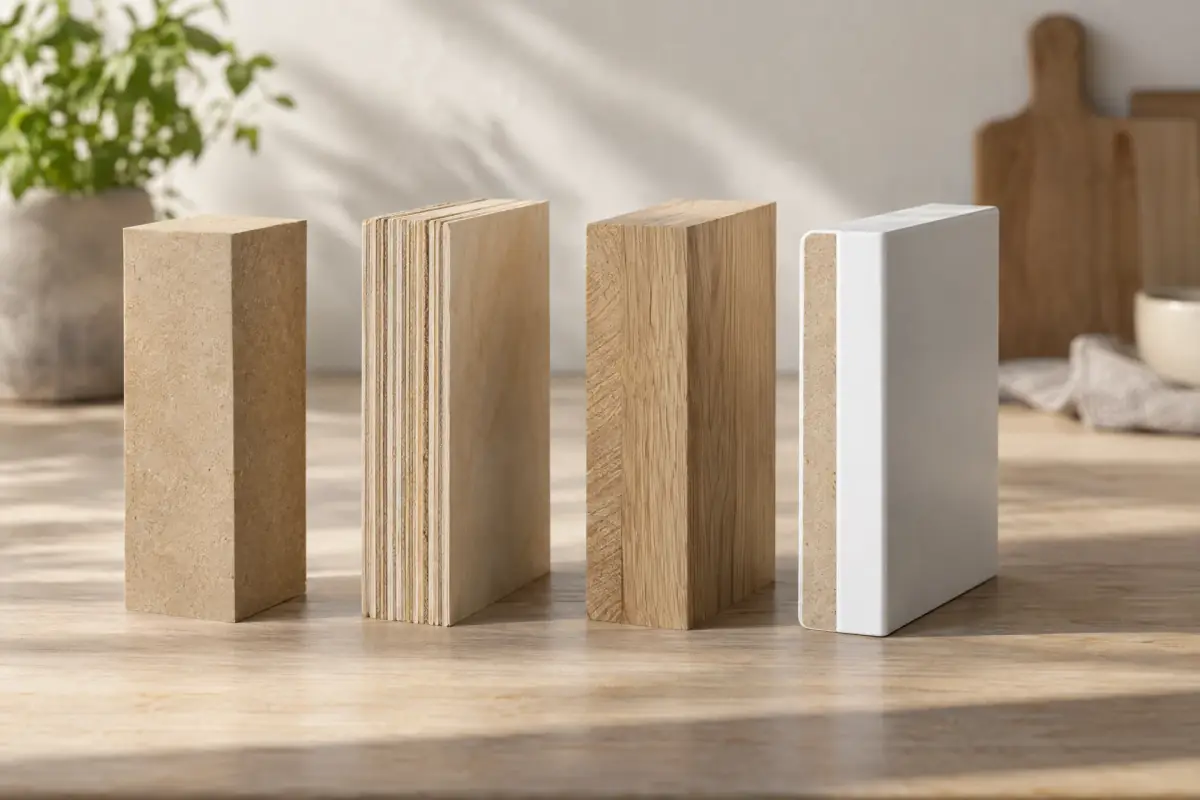
A cabinet door is a sandwich: a core, a skin, and an edge that holds them together. MDF gives you a smooth face that paints beautifully, plywood tolerates damp better, and solid wood can be sanded and refinished. None of them wins everywhere, and the finish on top often matters more than the core.
How each core is made
MDF is wood fiber and resin, pressed into a uniform board under heat. There is no grain, no direction and no knots, which is why it machines and paints so cleanly.
Plywood is an odd number of thin wood veneers glued in alternating directions. The crossed grain is what makes it stable, and the layers are what you see on an exposed edge.
Solid wood is sawn lumber, sometimes glued into staves to make a wider panel. The grain runs one way, and the board moves across that grain as humidity changes.
The materials guide covers how these cores are usually finished. Here, the focus is what each core does inside a door.
Moisture and humidity swings
MDF is the most sensitive of the three to water. A sealed face is fine; a raw edge is a sponge. Once the board swells it does not shrink back, and the paint film above it will crack. In a dry kitchen with a good exhaust fan, this rarely matters. Beside a steamy dishwasher or in a bathroom without ventilation, it matters a lot.
Plywood handles damp better because the glue lines interrupt the path of water through the panel. Its weak point is the edge, where water can get between the plies and lift them. Cheap plywood with voids in the core is worse than a good MDF board.
Solid wood moves. A panel expands and contracts across the grain with the seasons, which is why a frame-and-panel door leaves the center panel floating instead of gluing it tight. Restrain that movement and the panel cracks or the frame splits.
Screws, hinges and weight
MDF is dense and holds a screw well in the face of the board. The edge is less reliable, and a hinge that is removed and refitted a few times will start to spin. That is repairable, but it is a repair you notice.
Plywood holds screws well too, and it is lighter than MDF at the same thickness. Screwing into the edge can split the plies, so hinge plates and drawer slides need to land in the face or in a solid insert.
Solid wood has the best screw bite of the three and the easiest repair: drill out the hole, glue in a plug, re-drill. It is also the heaviest door, which changes the hinge you need rather than the door you can have.
The edge is a hinge decision
A door’s weight and its edge detail decide the hinge more than the material name does. A heavy solid wood door on a small overlay hinge will sag. A light MDF door on a poorly fitted plate will still bind if the edge profile is proud. When you order, ask what the door weighs and what hinge the maker recommends for it.
Paint, stain and the finish on top
Paint is where MDF earns its place. The surface is uniform, there is no grain to telegraph through, and a sprayed finish looks like glass. Plywood paints well on the face but needs its edges filled first, or the plies show as stripes. Solid wood always shows grain through paint, which is either the point or the problem.
Stain is the opposite story. Solid wood and veneered plywood take stain and clear finish beautifully. MDF does not stain. It has to be veneered first, and then you are really finishing the veneer, not the core.
Then there is the finish that sits on top. Paint is the most repairable. Veneer is a thin slice of real wood, sealed and often lacquered, and it can be patched but not sanded through. Thermofoil is a vinyl film bonded to a core, seamless and easy to wipe, but it can peel at an edge and it cannot be repainted. Laminate is a pressed sheet, tough and consistent, with an edge that is visible by design.
The finish is a separate decision
Most door arguments are really finish arguments. A thermofoil door is usually MDF underneath. A veneered door is usually MDF or plywood underneath. A laminate door is a core with a pressed skin. So the question is not only which core, but which core is under the finish you actually want.
Denting, chipping and cracking
MDF dents rather than chips. The surface compresses, the paint film cracks around the dent, and a painted door can be filled and touched in so that you cannot find the spot from standing height. At an exposed edge, MDF crumbles, which is why edge banding and a sealed profile matter.
Plywood chips at the edge and at the face veneer. A chipped plywood edge is difficult to make invisible, because the repair has to match both the face and the layered edge.
Solid wood dents, cracks and moves. It is the only one of the three that can be sanded back and refinished, which is why old solid doors are worth keeping and old veneered doors usually are not.
The four-column comparison
| Material | Best use | Weakness | Finish pairing |
| — | — | — | — |
| MDF | Painted doors, flat slab fronts, shaker panels, vanities with sealed edges | Swells at raw edges; screw holes strip if a door is re-hung often | Paint, thermofoil, veneer, laminate |
| Plywood | Damp rooms, large flat panels, painted or veneered slab doors | Edge delamination; face veneer chips; voids in cheap cores | Veneer, paint over filled edges, laminate |
| Solid wood | Stained doors, raised panels, period homes, anything meant to be sanded | Moves with humidity, can crack, heavier, costs more | Stain and clear finish, painted frame-and-panel |
The sandwich and the edge
Think of a door as a sandwich: core in the middle, skin on the face, edge detail all the way around. The core decides how the door behaves. The edge decides how it survives.
Edge details are not decoration. They change how a door wears:
- A square edge with banding is crisp and modern, and it is unforgiving of a bad joint.
- An eased edge is softer, hides a small chip and suits flat slab fronts.
- A chamfer creates a deliberate shadow line and works well on handleless runs.
- A molded or profiled edge is traditional, with more surface to dust.
- A frame-and-panel edge lets the frame protect the panel while the panel moves inside it.
An MDF door with a profiled, sealed edge behaves very differently from one with a bare cut edge. A plywood door with exposed plies looks like a shop offcut, however good the face. A solid wood frame with a floating panel, the classic raised-panel door, is not a solid slab at all. It is a system designed to let the panel move.
This is where a stock door and a made-to-measure door part company. If you are matching existing boxes, the core and the edge profile are usually specified together, and custom cabinet doors made to your measurements are where that conversation belongs.
Three households
The bathroom with a hot shower
A small bathroom that steams up twice a day is the hardest room in the house for MDF. A sealed, painted MDF door with a good fan will survive. A thermofoil door is easy to wipe, but its edges are the first thing to lift. Plywood or a solid wood frame gives you more margin, and a beadboard door with sealed grooves is a sensible third option.
The family kitchen with the dishwasher at the end
The end of a run next to a dishwasher takes steam, heat and the occasional leak. Plywood is the calmer choice for the end panel, and a sealed MDF door is fine if the edge is properly finished. Whatever you choose, look at the end panel as carefully as the doors, because that is where water shows first.
The period home with a stained run
If you want to see grain, the core has to be solid wood or veneered plywood. Paint over MDF would hide the thing you are paying for. Accept that a solid panel will move, choose a frame-and-panel construction that gives it room, and plan to re-oil or re-wax rather than repaint.
What I would do
I would choose the finish first, because that is what you look at every day, then pick the core that supports it and the edge detail that protects it. Painted flat doors in a dry kitchen: MDF, sealed edges, no drama. A steamy bathroom or a run beside a dishwasher: plywood or a solid frame, and I would spend the difference on ventilation. A stained period kitchen: solid wood, and I would leave room for it to move. The right core is the one that suits the room, not the one that wins an argument online.
Keep reading
All guides
Painted vs stained cabinets in a busy kitchen
Paint hides grain and forgives touch-ups; stain shows wood and punishes chips. How each finish survives grease, steam, kids and sunlight in a busy kitchen.